share:


While both terms are used interchangeably in the realm of eCommerce, they actually serve different purposes.
Almost everyone can tell what’s a ‘warehouse’. But when it’s compared to a ‘fulfillment center’, things become a bit more like a logistics puzzle. For eCommerce businesses, making sure orders arrive on time at their destination depends on how efficient is the warehouse (or fulfillment center). If you’re thinking of improving your supply chain (or just want to feed your curiosity), read on to understand the differences between these terms.

In its simplest form, a warehouse is a large storage facility designed to store goods and products in bulk. Typically, warehouses are used by manufacturers, importers, exporters, wholesalers, and retailers to house inventory for extended periods. The primary purpose of a warehouse is to safely store goods until they are needed, without focusing on the speed of processing orders.
Warehouses are equipped with shelves and pallets to keep products organized and accessible (and, of course, they have dozens of quirky forklifts). Warehouses are essential for managing inventory levels, preventing stockouts, and maintaining the supply chain's efficiency.
As an eComm brand, owning (or leasing) a warehouse might seem like an attractive solution to save on cost. But unless you’re selling on a massive scale to justify such investment, you’re better off outsourcing your warehousing needs to specialized providers.

The concept of fulfillment centers started to gain popularity amidst the meteoric rise of eCommerce during the ‘90s. Today, this term can refer to many things. But in its essence, a fulfillment center is a facility designed to handle the logistics of processing and shipping orders to customers.
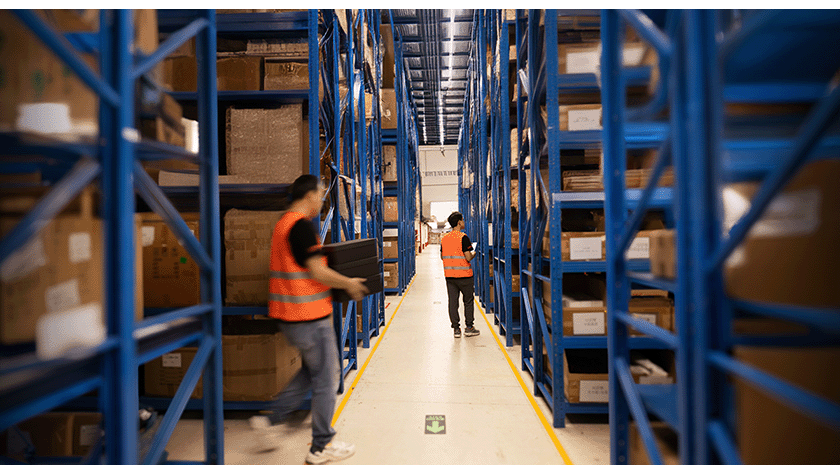
Fulfillment centers are an integral part of eCommerce businesses and any third-party logistics (3PL) operations. It’s where the speed and accuracy of order fulfillment are paramount. These centers receive products, store them temporarily, pick and pack items as orders come in, and then ship them out to customers’ front door.
Fulfillment centers are far more active than traditional warehouses. They manage various time-sensitive tasks, including inventory management, order processing, packaging, shipping, and sometimes even returns handling. The goal of a fulfillment center is to provide a seamless and efficient order fulfillment process, enhancing customer satisfaction.
Now that semantics are out of the way, it’s clear that a fulfillment center is the ideal option in most cases. To ensure timely delivery, reduce errors, and handle returns, an eCommerce fulfillment center does much more than a conventional warehouse.
But don’t let the names deceive you! Warehouses and fulfillment centers are both used to refer to facilities that process orders and store goods. While a fulfillment center can also operate like a warehouse, some modern warehouses are also equipped with everything needed to ensure efficient eCommerce fulfillment, therefore operating like a fulfillment center.
Some companies call their fulfillment centers a ‘warehouse’, which is exactly the case for us at Lansil Global. Our warehouse in Shenzhen, China, for instance, offers even more than a traditional fulfillment center – we store goods, fulfill eCommerce orders, perform quality control checks, and even prepare orders for Fulfillment by Amazon (FBA). With two additional warehouses in the United States, we offer USA order fulfillment with 2-4 day standard delivery across all states.
Are you looking for a reliable fulfillment partner to boost your supply chain? Reach out to us today and learn more about how we can take your business to new heights.
If you like to experience the harmony of fulfillment centers, warehouses, FBA prep centers, and quality control in one place, we’re more than happy to invite you for a visit to our Shenzhen warehouse as well.
Book a call today and let’s get started!
Enjoying our blog? You may also like:
Stay in the loop with
Our Industry Insights